| This
to encourage and honour individuals, partners or
groups representing different aspects of contemporary
visual practices – painting including traditional
and folk forms, handicrafts, graphics, sculpture,
photography, internet, web and video art, as well
as interdisciplinary practices.
Last three years Awardees |
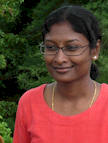
Employing organic materials
invested with tradition and history, Ranjani creates
multidimensional works that bring forth the metaphysical
attributes of residing within a changing physical
environment. Shettar’s work embodies the relationships
between the future and past, exposing the permeability
of the often-distinct thresholds between craft and
art, tradition and modernity, and the physical and
the spiritual.
Transforming simple and mundane materials into the
magical, Shettar uses materials such as muslin, tamarind
powder, old car parts, lacquered wood and wax beads
in her installations, appearing effortlessly natural
but at the same time intricately crafted, to evoke
the multiple, intersecting histories of the material.
It also alludes to cycles of consumption and commodification,
prompting analysis of what a technology-driven modernity’s
relationship is to nature.
Inspired by nature and drawn from experience, Shettar’s
work combines movement in form and content in which
exacting lines sculpted in space are invested with
the attributes of the employed materials, as in Just
a bit more, a monumental installation of thread
and tiny beads of wax or in Me, No, Not Me, Buy
Me, Eat Me, Wear Me, Have Me, Me, No, Not Me,
in which old car parts are woven into elegant and
organic flowing forms.
Philippe Verne, Director of Dia Art Foundation, described
: “The driving force behind Ranjani’s
work is a poetics of Space. Whether destined for public,
private, or even intimate settings, her art takes
account of the physical-almost molecular, organic-and
emotional nature of the space in question”.
|
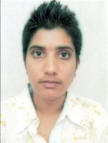
Tejal is a visual artist
working with video, photography, performance, sound
and installation. Her work, like herself, is feminist,
queer and political. Her works have been exhibited
widely in museums, galleries and film festivals including,
Lost and Found - Queerying the Archive, Nikolaj
Contemporary Art Center, Copenhagen, 2009; Asian
Triennial Manchester, Cornerhouse, Manchester,
2008; City of Women International Festival of Contemporary
Arts, Ljubljana, 2007; Global Feminisms - the
inaugural show at the Elizabeth Sackler Center for
Feminist Art, Brooklyn Museum, NY, 2007; Saturday
Live, Tate Modern, London, 2006; Sub-Contingent
at The Fondazione Sandretto Re Rebaudengo, Turin,
2006; Indian Summer at The Ecole Nationale
des Beaux Arts, Paris, 2005. Solo exhibitions include
“What are You?”, Thomas Erben Gallery,
New York and Galerie Mirchandani + Steinruecke, Mumbai,
2006; The Tomb of Democracy, Alexander Ochs
Gallery, Berlin, 2003. Her work is in the collection
of Centre Georges Pompidou, Paris; Lekha and Anupam
Poddar collection, New Delhi and several private collections
in India and abroad.
In 2003-4, she co-founded, organised and curated Larzish
– India’s premier International Film Festival
of Sexuality and Gender Plurality. She grew up in
central India, Chhattisgarh, eventually moving to
Mumbai in 1995. She holds a BA in photography from
RMIT, Melbourne and has been an Exchange Scholar at
the Art Institute of Chicago. Currently finishing
her MFA part-time from Bard College, New York, Tejal
works out of her laptop and Mumbai city.
|
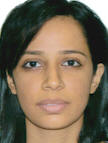
Prajakta’s work dwells
between the intimate world of an individual and the
world outside sometimes separated only by a wall.
“Walls” intrigue her as they are a witness
to history and have traces of inhabitance embedded
in them. As much as a wall might be sealed, there
tends to be porosity that allows things from the outside
to come home or vice versa. In between these public
and private spaces various elements transgress and
remain as residues of this phenomena.
By transforming the everyday mundane experiences into
fantastical imageries, her attempts are to create
escape routes within the chaos of the city. Her works
try to reflect a sense of irony experienced in day-to-day
life.
Prajakta’s practice tries to trace these imperceptible
elements that affect the psyche of individuals. Her
practice has involved painting, site-specific sculptural
installations and photography. In 2010, her work was
exhibited in a traveling museum show, “Indian
Highway“ at the Herning Museum of Contemporary
Art, Denmark and the Astrup Fearnley Museum, Norway.
Her work is also part of “India Awakens - Under
the Banyan tree “at The Essl Museum of Contemporary
Art, Austria.
Prajakta has also been featured in significant publications
like ‘I’m Not There: New Art from Asia,’(2010)
Edited by Cecilia Alemani published by The Gwangju
Biennale Foundation. In 2009 she was also featured
in Younger than Jesus : The artist directory co-published
by the New Museum and Phaidon.
|